

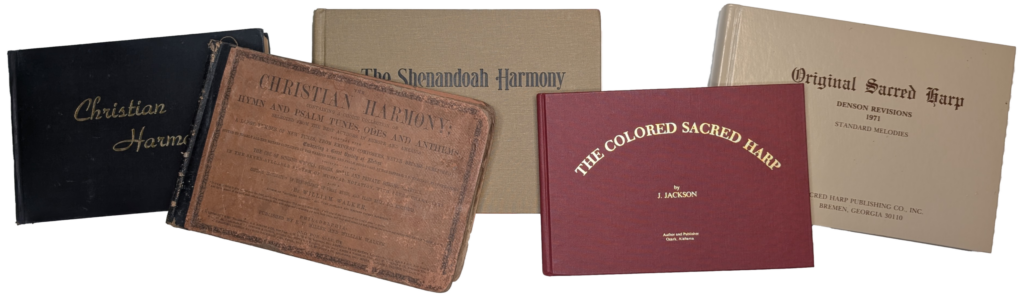
One hardly expects a midcentury children’s Western to pause for a detailed lesson in shape-note singing, yet that is precisely what happens in Idena McFadin Clark’s Little Dude, a 1952 novel about young Jim MacFarlane and life on a Texas ranch in 1872. Amid the book’s frontier adventures, Clark depicts a community singing with remarkable specificity: the singers compare The Sacred Harp, The Southern Harmony, The Union Harmony, The Christian Harmony, and The Knoxville Harmony; debate four-shape and seven-shape notation; organize themselves into tenor, treble, counter, and bass parts; key the opening chord; and sing first by shapes and then with the words. The scene is comic, but it is neither incidental nor generic: it preserves a surprisingly informed portrait of shape-note practice as part of the social fabric of nineteenth-century rural life. The following excerpt comes from the chapter appropriately titled “I Been Scalped!”
Mr. Daniels rapped for silence. “We ought to begin the singing,” he said. “Brother MacFarlane has consented to start us off. So I’ll turn the meeting over to him.”
Pappy stood up. “Well, first thing we ought to do is line up the books we have here,” he said. “I have my Sacred Harp book and my wife has her mother’s Southern Harmony. Brother Jackson, I understand you to say you have the Union Harmony?”
“That’s right, and Grampa brought along the Sacred Harp and Southern Harmony he used in his teaching days.”
“We have the Sacred Harp,” Mr. Hunter boomed out, and held up a pitifully dog-eared copy to prove it.
“I never use a book,” Mrs. Hunter explained loudly to no one in particular. “I sing by ear.”
That made Jim smile. “The whole county knows she can’t read a note or a word,” he whispered. Charlie scowled and silently threatened Jim with his doubled-up fist.
Mr. Daniels cleared his throat. “My wife and I feel the old four-shaped notes are no longer trustworthy guides to music.* We prefer the more up-to-date Christian Harmony.”
Gramma spluttered. “He’s talking about them newfangled 7-shaped note songbooks! What’s been good enough for his folks for more than four hundred* years ought to still be good enough—and for his stuck-up in-laws, too!” She clamped her toothless mouth together and glared at her daughter-in-law.
“I have always preferred the Knoxville Harmony,” Miss Effie offered primly. “It has all the really good sacred songs, and many others, too, like ‘Home, Sweet Home.’”
“And ‘Turkey in the Straw,’” Gramma interrupted bitterly. “Such songs ain’t fit to be put in a book with God’s songs!”
“Now, now,” Pappy put in quick. “All this ain’t getting us any place. I suggest we start the day with that old favorite ‘Albion.’ You’ll find it on page 52 in the Sacred Harp.”
“You young folks haven’t been to a singin’ for some time,” he went on. “Might as well tell you now we can’t have any talking, laughing, or loud untuneful singing for that spoils our harmony and ruins our enjoyment of the music. First thing we do is key off. I’ll key the beginning note for the tenors, Sister Jackson for the counters, Grampa for the bass and Sister Aurelia Daniels for the treble. Then all of us together will sing the opening chord. When that’s right we go on through the tune by note. After we do that, the tune’s set in our head so we can go back and sing the words. Now you understand? Then let’s start.”
“Faw.” Pappy’s first note came out clear and strong. Almost immediately the other tenors came in on pitch. He pointed to Mrs. Jackson, and the lovely golden tones of the counters joined the tenors, “Faw.” Then Grampa Rice led the basses, “FAW.” And Mrs. Daniels chimed in with the high shrill note of the trebles, “FAW.”
Then Pappy started them in again.
Faw! Faw . . . FAW . . . Faw!
He nodded. “That’s good! Now we’re ready to sing the tune through.”
When they had sung all through the tune by note, Pappy started them back over the words: “Come ye that love the Lord and let your joys be known.”
It was enough to make you cry, Jim thought. He was sure he saw a few tears roll down Grampa’s cheek. Even Mrs. Hunter’s shrill treble slid around a time or two, at the start. But when they had come to the end of the song everybody was smiling.
“Well, sir, that’s a good starter,” Pappy beamed. “What do you want to sing now?”
“Let’s sing something in a minor,” suggested Mrs. Hunter. “Minor music suits my voice better.”
“Well, there’s a minor tune to the song ‘Promised Land’ on page 128 in the Sacred Harp. It’s on page 51 in Southern Harmony.”
This was Jim’s favorite song.
“On Jordan’s stormy banks I stand
And cast a wishful eye—”
He liked the next one, too. Pappy must have chosen it so Mrs. Daniels could show off her voice. It had a lot of slurs in the treble part, especially at the end.
All of them sung together.
“All hail the power of Jesus name
Let angels prostrate fall.”
Then only the trebles and basses went on:
“Bring forth the royal diadem.”
And altogether again and swelling into loud full tones:
“And crown Him Lord of all.”
Then Pappy signed them to repeat, very softly:
“Bring forth the royal diadem
And crown Him Lord of all.”
By that time folks had loosened up, and the clear harmony poured out in song after song. Jim settled down on the bench back of the main tenors and listened to the singing.
By now the little room had grown hot and stuffy. Some of the women had taken to beating time with their fans or with their books. Large blue flies came in through the open windows and the door, and circled sluggishly around the room just under the ceiling. They flew heavily, as flies do just before a rain, and seemed ever more willing to light than to fly.
One big blue booger especially interested Jim. He watched it glide lazily around the room, and settle at last on the smooth pink top of Grampa’s nodding head. The old man jerked a little, once or twice, but the fly hung on.
Charlie nudged Jim. “I bet I can hit that fly and never even wake Grampa up,” he whispered.
Jim grinned. “I’ll bet!” he doubted.
“I can,” Charlie insisted. “Watch me!”
He pulled a short willow tube from one of his large pockets. From another he fished out a handful of black-eyed peas. He selected one of the smaller peas and placed it in one end of the tube.
“I’ll show you,” he promised and put the tube to his mouth.
“Wh-h-ft . . . t,” the pea shot out of the tube and straight to its target.
“Whoop!” Grampa jumped to his feet and started to holler. He blinked both eyes hard but he kept on hollering:
“Run for your lives, folks! The Injuns are here! I been scalped!”
* The four-shaped (fa sol la mi) notation was used in Elizabethan England.
Leave a Reply