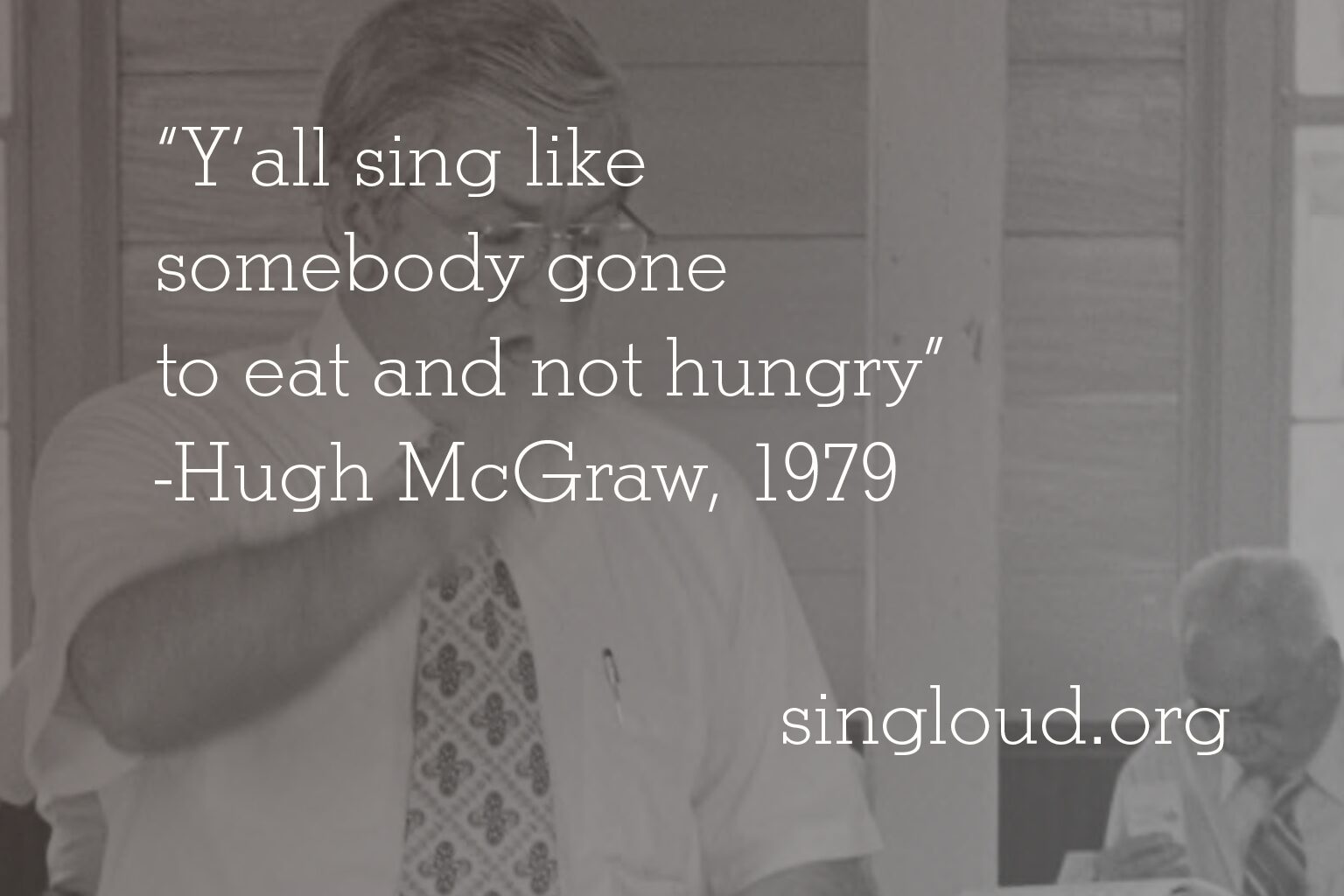
“Y’all sing like somebody gone to eat and not hungry.” That was the advice Hugh McGraw gave a group of music majors in North Fulton over 40 years ago. This transcription from a 1979 edition of The Atlanta Journal reminds us that while pitch is important, the spirit is everything. Read on for a classic look at a singing school in action, where the goal isn’t just to listen, but to participate. It also notes that Hugh “led a group of 50 singers on the Mall while awaiting the appearance of Pope John Paul II.”
Forget the Words, Just Sing the Notes
By Katheryn Hayes
Reporter, North Fulton EXTRA
Hugh McGraw is not a music scholar, but he can sing circles around the pros in his own forte — Sacred Harp singing. Choir members and Sigma Alpha Iota music majors lifted their bewildered faces to McGraw as he patiently taught them the fine points of the art. “Y’all sing like somebody gone to eat and not hungry,” he told the group and they tried to separate their fa’s and la’s. “Get with it,” he admonished.
McGraw — known in some circles as “Mr. Sacred Harp” — had the attention of a collection of well-trained voices for a lesson last week at the Episcopal Church of the Atonement on High Point Road. The class was sponsored jointly by the church and Sigma Alpha Iota. As an authority on the old time form of singing, McGraw is a rare expert. He recalled a musician who criticized his pitch. McGraw told the critic, “A professional is someone who knows what he’s doing. I’m a professional Sacred Harp singer. They might’ve wrote this song in the wrong key.”
Sacred Harp, also known as “four note” or “shaped note” singing, originated in the rural South. It has gone on in country churches for two centuries. A Breman, Ga. native who works for a clothing manufacturer, McGraw spends his free time traveling around and carrying on what he calls a family tradition. His most recent Sacred Harp performance was in Washington, D.C. He led a group of 50 singers on the Mall while awaiting the appearance of Pope John Paul II.
The fun to be had in this art form is not listening, but participating, he said. “I wouldn’t walk across the street to hear Sacred Harp singing,” he told a surprised group of willing students. “But I’d walk a hundred miles to help sing it.” Sacred Harp tunes are the same as other hymns: “The Promised Land,” “Amazing Grace,” “Wondrous Love,” all the old stand-bys. The difference is the singers don’t use words, they sound notes.
The printed music is accompanied by tiny notes printed in various shapes. Each shape represents a different note, and thus a different sound. This form of music began because “singing the notes” proved to be the best way to learn the tune, he said. “But we liked singing the notes so good we kept singing them.” McGraw’s forte is four-note, but there is also seven-note Sacred Harp. The four notes McGraw presented to his students are: fa, represented by a triangle; so, represented by a circle; la, a square; and mi, a diamond.
The practice of singing these notes is quite informal. “If you’re calling a fa a so, don’t be embarrassed,” he said. “It’ll fit.” Some notes show two shapes instead of one, say a fa and a so or a mi and a la. Those are called choice notes, according to McGraw. “You sing either one you want.” If you want to know about the other three notes, you’ll have to find a seven-note singer. So far as we know, there aren’t any in North Fulton. But North Fulton does boast a healthy number of four-note singers, most of them in Roswell and in Alpharetta, according to McGraw. In Alpharetta, they get together for a big sing at city hall.
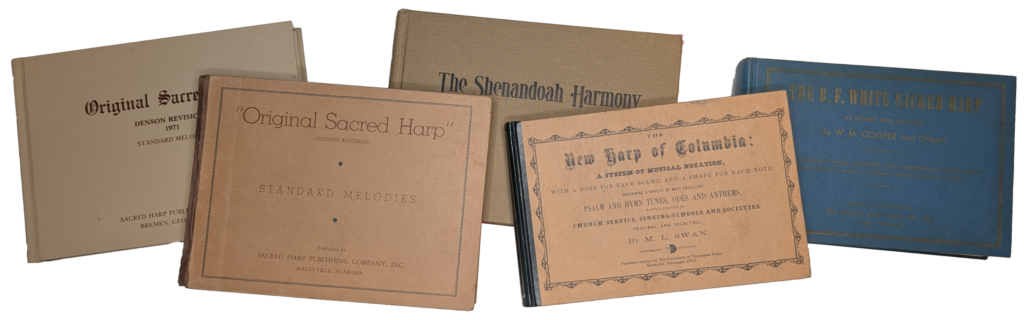
In fact, one young Roswell woman who attended last week’s lesson is a sort of Sacred Harp heiress. Sally Combs’ great-grandfather, Thomas Byrd Newton, was one of the editors of the 1911 version of the Sacred Harp song book. The tattered old volume lay on the chair beside her. The art has been handed down to today’s practitioners through a series of volumes of “Sacred Harp,” the song book that has given this type of singing its name. Ms. Combs, a school teacher, said she had never tried to sing Sacred Harp before last week. But she knew her great-grandfather had made his living teaching it, and she was determined to give it a try.
More than 750 Sacred Harp sings are scheduled in the South each year, according to McGraw. Most, but not all, are held in Primitive Baptist Churches. They are held in these churches, he said, because the Primitive Baptists are usually small, rural congregations which meet only one Sunday a month. The churches are available on the other Sundays, so they often turn out to be the best place to hold a sing, or, better yet, a singing school, he said. There are Primitive Baptists around who would tell you they sing Sacred Harp because they like it. They even sometimes go to church on weekdays to get a chance to do it.
While fewer Southerners sing Sacred Harp now than in the old days, McGraw said the style is catching on in the North and West, particularly with young people. “But down here, most of us are old timers,” he said. Getting down to the business of singing Sacred Harp, McGraw sat all his students in four sections: soprano, alto, tenor and bass. On each song, they harmonized in fa’s and la’s and then in standard lyrics.
A group of Sacred Harp singers sounds a little like a quiet orchestra — a lot of different notes that somehow come together in a reasonably pleasing fashion. The voice is the only instrument used in Sacred Harp singing, except for a mouth harp which establishes the pitch. Primitive Baptist churches, the primary theater for Sacred Harp, don’t use musical instruments at all, not even a Sunday organ.
Leave a Reply