SingLoud.org is pleased to present “Shape-Note Singing with Hugh McGraw,” a recording of a remarkable shape-note singing exhibition organized by the American Folklife Center of the Library of Congress with local singer Kathy Manning. This titled and edited video, prepared by Kevin Isaac, is being made publicly available for the first time. The source footage, provided by Kathy, was digitized from videotapes produced by the Library of Congress at the time, and the limitations of the original material are evident in the visual quality. Nevertheless, the sound compares favorably with many archival Sacred Harp recordings, and this presentation is likely as good as we will ever get. Captions for each speaker and overlaid lyrics for every song help viewers follow along.
The singing took place in the Coolidge Auditorium of the Thomas Jefferson Building at noon on Friday, July 24th, 1998, as part of the “Religion and the Founding of the American Republic” exhibition. It was one of four musical events presented in connection with the exhibition, including: a dramatic performance of Jonathan Edwards’ sermon Sinners in the Hands of an Angry God by Donald Marshall (June 26); a Moravian music concert performed by the Amernet String Quartet (July 10); and a closing performance by Sweet Honey in the Rock (August 7).
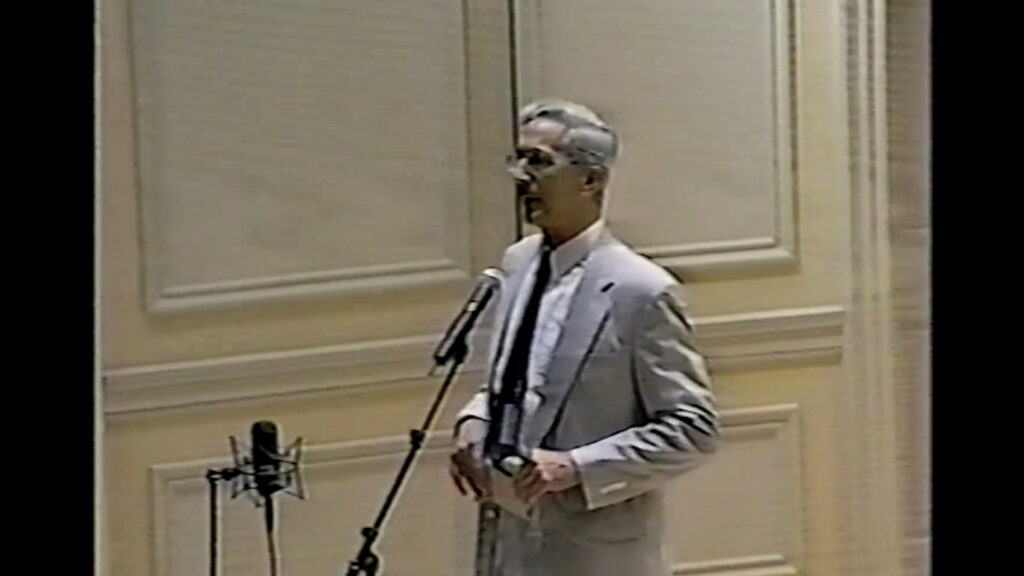
Alan Jabbour, then head of the Folklife Center, gives some background and framing of the event itself and of shape-note music and The Sacred Harp tunebook. Jabbour then called up Hugh McGraw to lead the afternoon’s exhibition. McGraw was one of the most tireless and influential figures in the Sacred Harp tradition. He began singing at the age of 25 and quickly became one of its most devoted teachers, composers, and organizers. As executive secretary of the Sacred Harp Publishing Company from 1958 to 2002, he oversaw major revisions of the tunebook—including the important 1991 Edition—and helped spread the tradition beyond its Southern roots. In 1982, he was honored with the National Endowment for the Arts’ National Heritage Fellowship, the nation’s highest award in the folk and traditional arts.
The event was a significant moment in the ongoing revival of Sacred Harp singing and followed a few years after the released of the 1991 Edition of The Sacred Harp, one of the most impactful revisions of the book—on par with the first James or Denson editions. It marked a wonderful moment of collaboration between singers from traditional Southern singing communities and newer Mid-Atlantic singers, offering a glimpse into the evolving reach and vitality of Sacred Harp traditions at the close of the twentieth century.
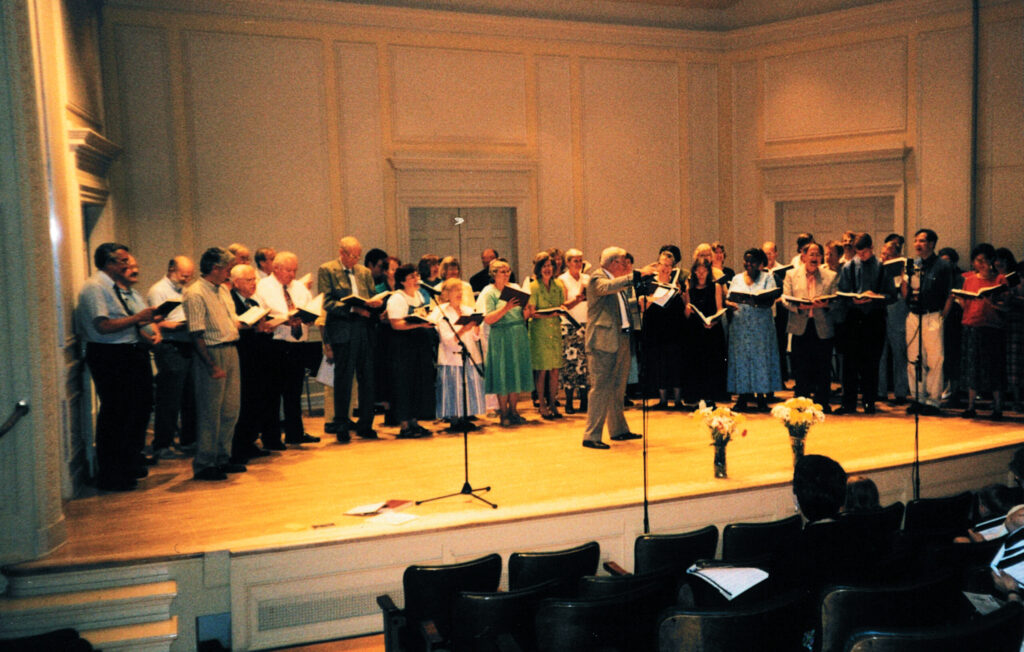
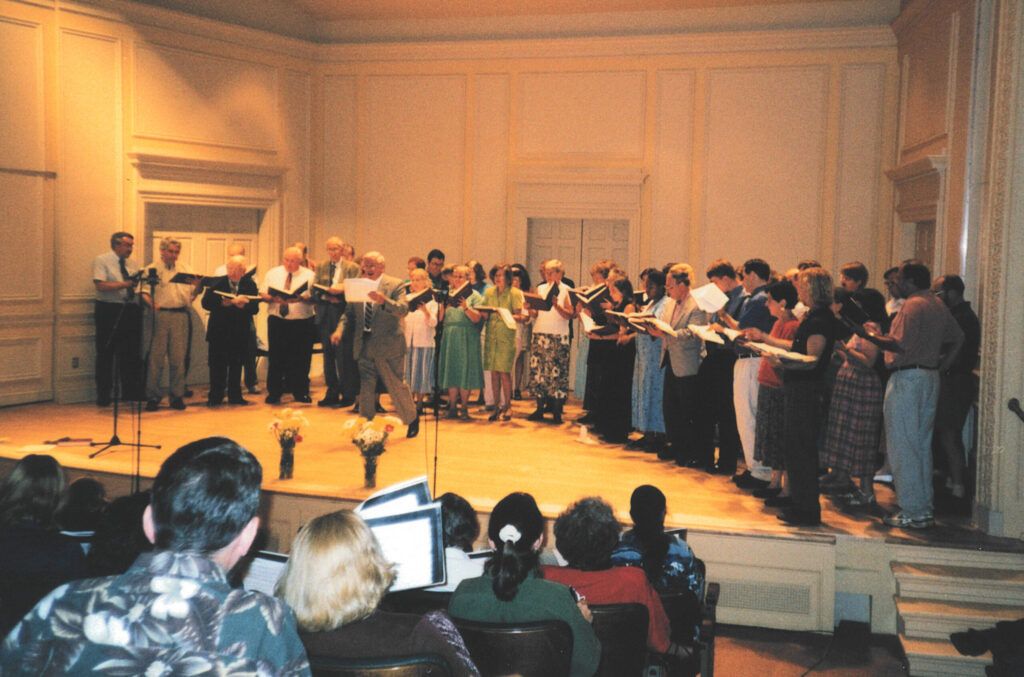
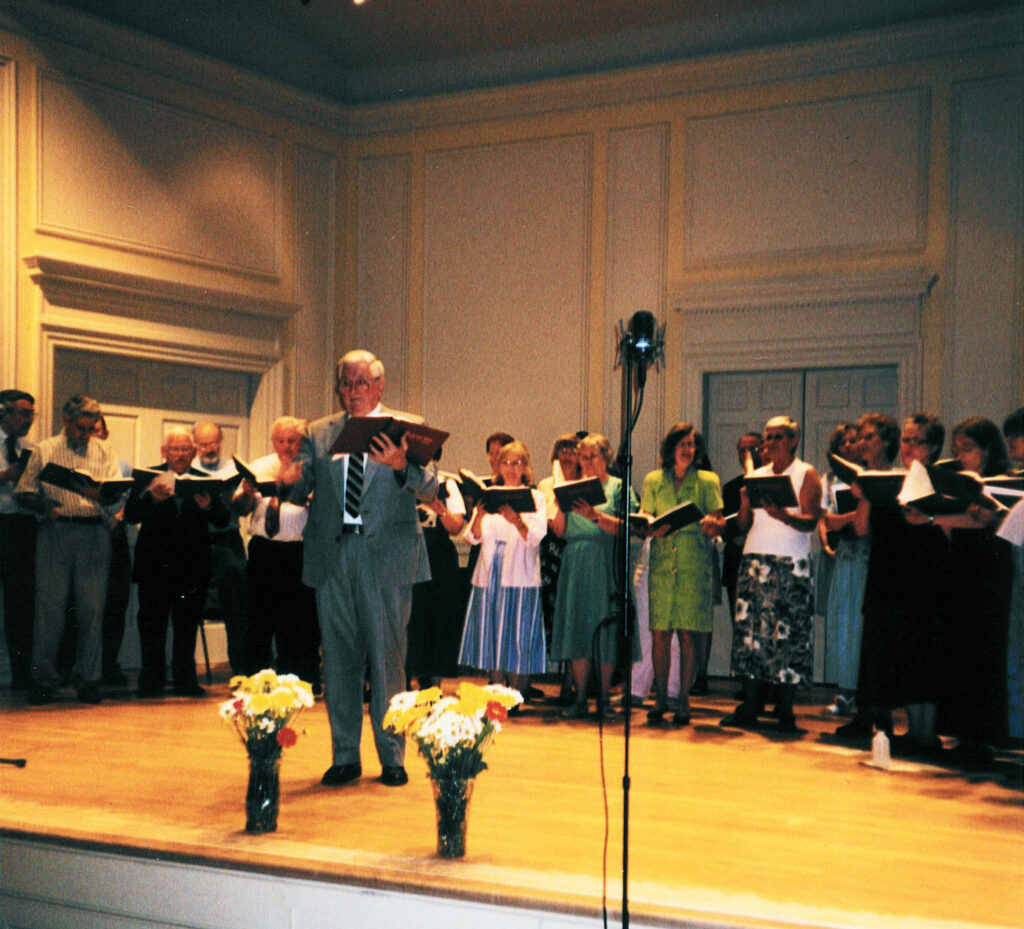
One immediate distinction of this performance is that it does not attempt to replicate a traditional Sacred Harp “singing.” While the singers are roughly organized by vocal part, they are arranged in a curved line across the stage, facing the audience. This departs from the traditional hollow square formation, where singers face inward with no designated audience. Such a format is rarely practical for public exhibitions, and performances like this often adapt to the venue and context.
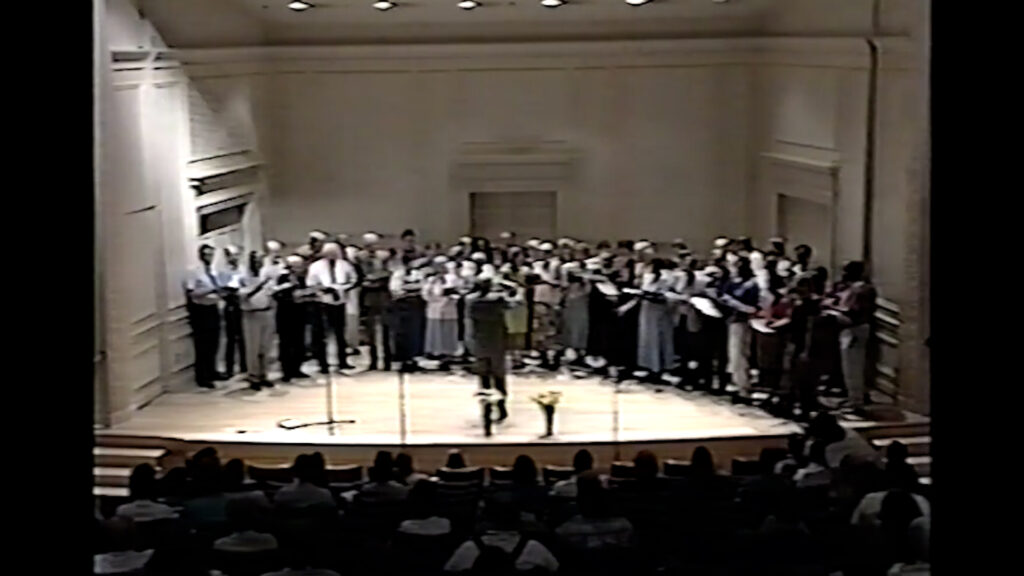
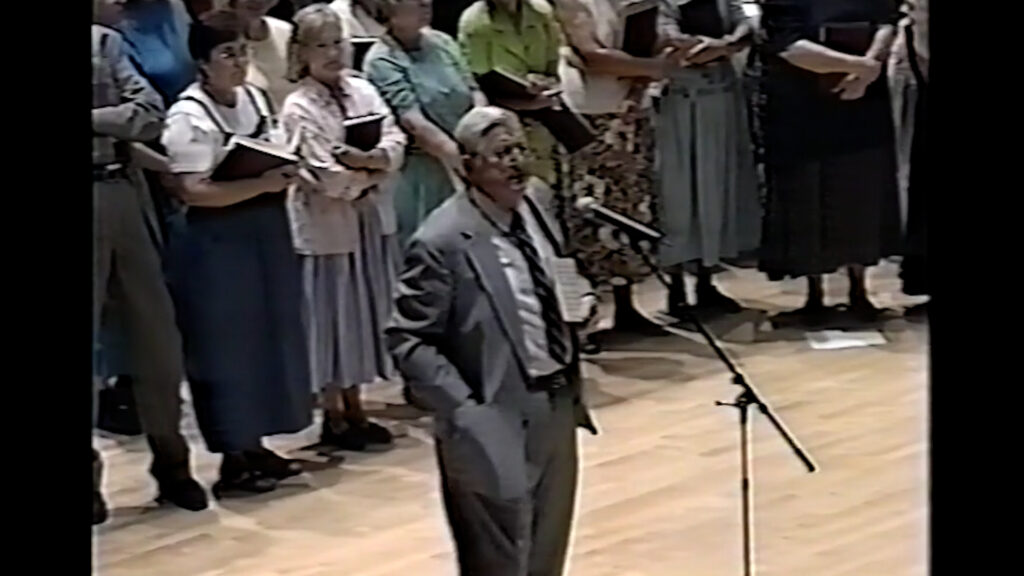
Another departure from tradition is that Hugh McGraw served as the sole leader throughout the event, guiding the group through his selection of tunes. In typical singings, leadership rotates among participants, with different individuals taking turns leading songs. McGraw began by calling up a core group of Southern singers from Georgia and Alabama. After offering historical context, they sang the shapes to “Old Hundred,” one of the oldest tunes in The Sacred Harp, originally composed in 1551. He then invited about 45 regional singers to the stage, who sang through a total of sixteen tunes, including two selections from other tunebooks.
The video features the following songs, in order of performance: 49 Old Hundred (solfege only), 332 Babylonian Captivity (The Southern Harmony), 46 Let Us Sing, 137 Liberty, 503 Lloyd, 479 Chester, 29 Fairfield, 273 Milford, 500 Living Hope, 501 O’Leary, 308T Nettie (new at the time, later published in the “Cooper Book” version of The Sacred Harp), 358 Murillo’s Lesson, 146 Hallelujah, 45T New Britain, 510 Corley, 77B Holcombe, and 159 Wondrous Love.
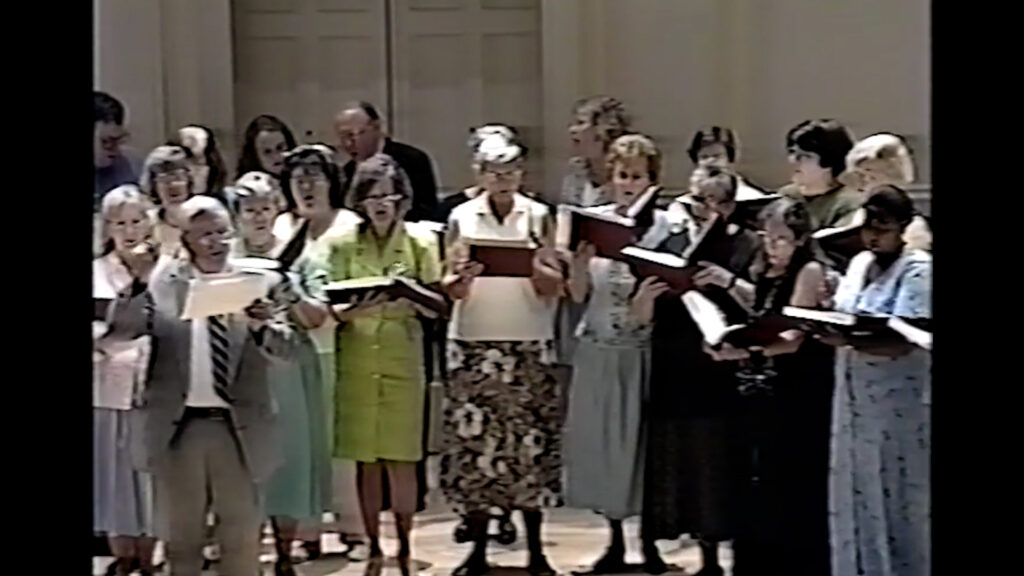
This video also preserves the voices and faces of a wide range of singers, some of whom are no longer with us. Thanks to the efforts of researchers and community members more than a quarter century after the fact, of the 50 or so on stage, the following singers have been identified:
Doron Henkin, Henry Bizzell, Dick Hulan, Louis Hughes, Fritz von Fleckenstein, Raymond Hamrick, Frank Evans, Ella Wilcox, Diane Menella, Roland Hutchinson, Claire Chapin, Amanda Denson, Buell Cobb, Carolyn Huckeba, Charlene Wallace, Kathy Manning, Faye Bressler, Donna Abrahams, Dottie Hurley, Karen House, Rosemary Greenaway, Gina Balestracci, Tim Slattery, Fred Beardsley, A. Gabriel Kastelle, Ronald Davies, Steven Sabol, Richard DeLong, Mary Wright, Gillie Campbell, and Bradford West.
Not everyone could be identified, and some individuals may have been misidentified. In at least one instance, a person confidently named by multiple attendees did not recall having been present. Despite these uncertainties, the documented participation represents a meaningful cross-generational and cross-regional snapshot of Sacred Harp’s enduring legacy.
A social gathering had been planned following the singing, but most participants were unable to attend. Tragically, this was the same day a shooting occurred just across the street, resulting in the deaths of two Capitol Police officers. The singers saw helicopters around at the time, but most did not learn the cause right away.
–Kevin
Oskar’s Images:
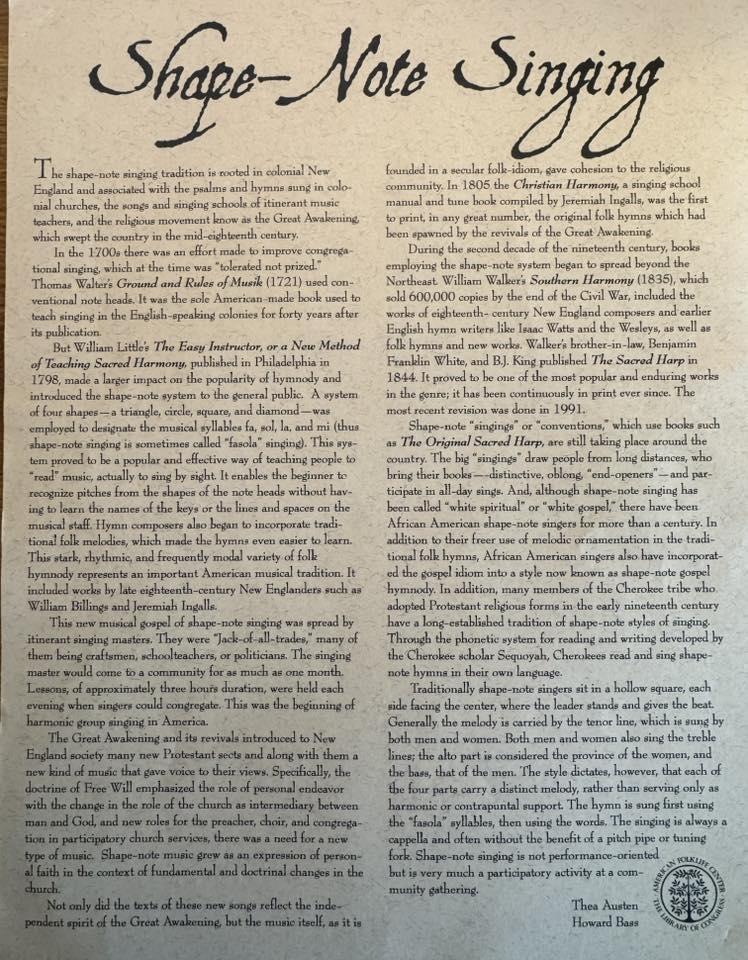
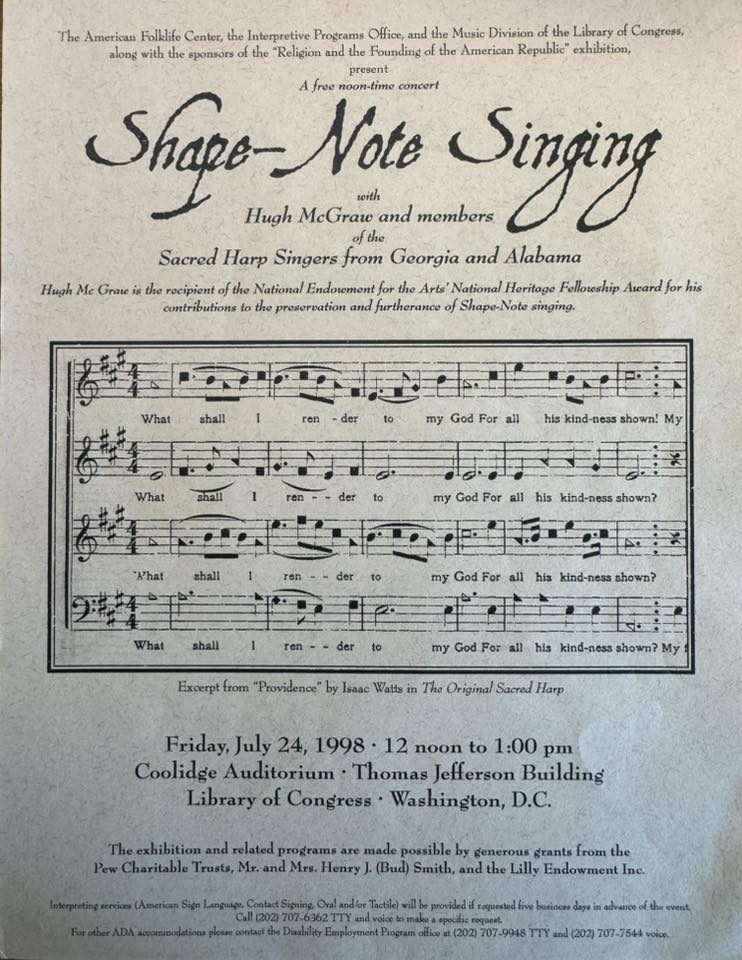
Oskar Kvasnes attended the event during a stay as an intern at the American Folklife Center, and has supplied us with thaove photos of the flyer produced for the event, and the photos of the singers on the stage below.
Introduction by Alan Jabbour
I am Alan Jabbour with the American Folklife Center, here at the library. Welcome to this concert—a concert of Sacred Harp singing. We’re thrilled to have it.
It’s in conjunction with the exhibit, which I hope you all have seen or will. If not, you will get a chance to go see it upstairs above the Great Hall in the northwest curtain, as they call it. The exhibition of the library is on religion in early America.
When they were completing the exhibition, they asked a group of us in both the Folklife Center and the music division whether we could think of any appropriate concert that would sort of go along with the theme of religion in early America. I suggested a Sacred Harp sing, though I insisted: “Now we’ve got to make this point that it is something that’s associated with early America, but it’s also alive and well today in the 20th century. And so we don’t want to act like it’s something that’s lost and forgotten.”
It’s a wonderful, exciting musical tradition—as American as they can get—though, of course, it has European roots that developed in New England and then along the early frontier in the Mid-Atlantic and in the South.
The original Sacred Harp hymnal was published in 1844, and it’s still in print. And Hugh McGraw—who organized the group who’s come to sing with us today—is with the Sacred Harp Publishing Company, which keeps that hymnal in print. Hugh’s from Bremen, Georgia, but the group that he’s brought up includes singers from both Georgia and Alabama who are part of the active and ongoing Sacred Harp singing tradition in the Deep South today.
Before I bring Hugh up, I just want to acknowledge Kathy Manning, who was our local contact. Washington, D.C., has had shape-note singing, particularly Sacred Harp singing, going on ever since the 60s. And it’s an active tradition. And so, when Hugh McGraw and his colleagues come up from Georgia and Alabama, it’s a great chance for us to get together with some of our longstanding and devoted singers from the Washington area, and that’s just what has happened today.
I would also like to acknowledge Amanda Denson and her son, who are here representing the Denson revision of the Sacred Harp. Denson is one of a number of family names associated with the Sacred Harp publication in its various editions over the years. And also, my old friend and colleague Raymond Hamrick, who it’s great to see again. I saw him many years ago in Georgia and perhaps here in Washington as well. It’s good to see you again.
I’m not going to do any more introducing. I’m going to leave the introducing to Hugh McGraw, who is here. Hugh, come join us.
(This introduction transcribed and edited into essay format by singloud.org.)