
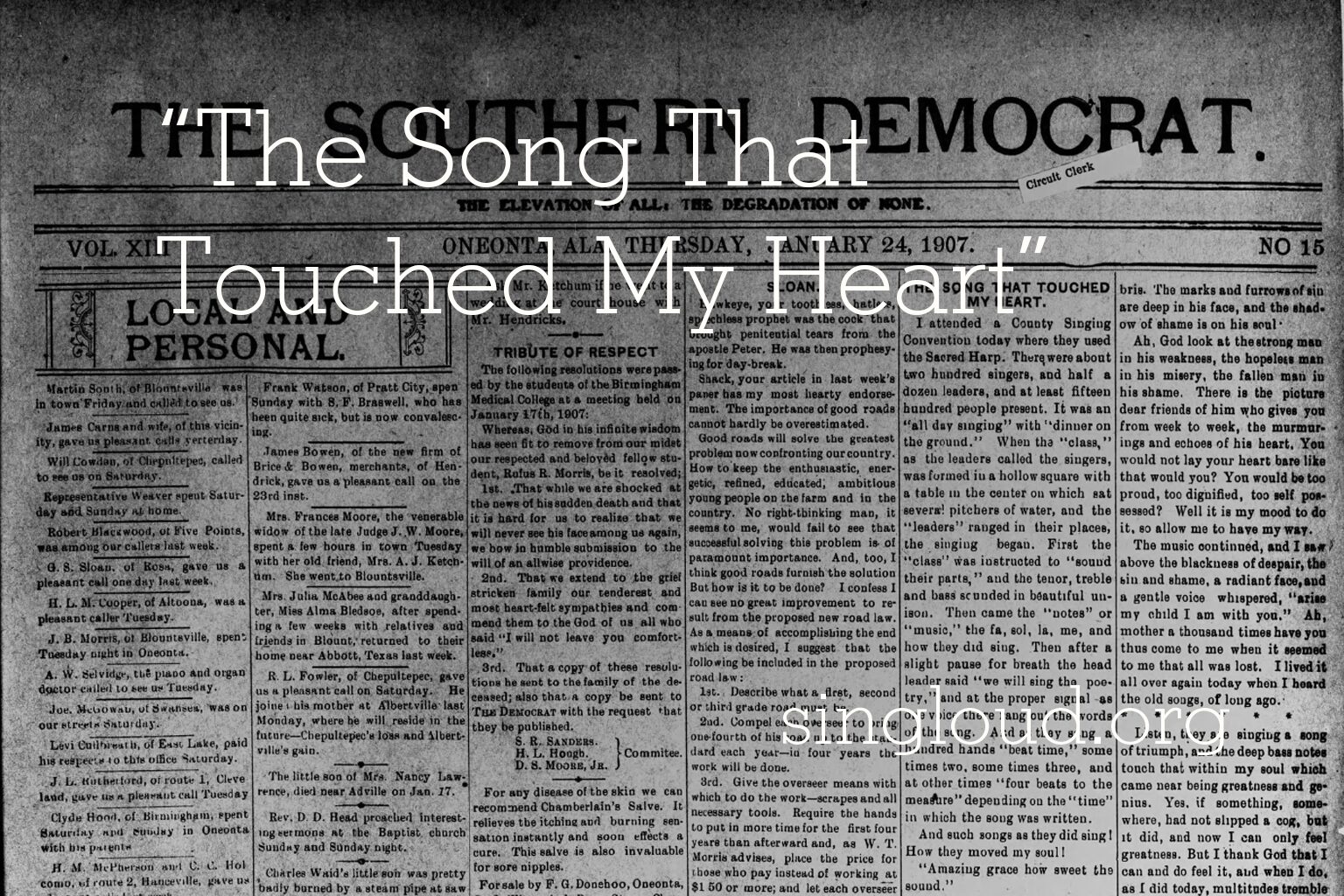
The Southern Democrat of Oneonta, Alabama, was published from 1894 until 1989, reporting on Sacred Harp singing over the entire run. The Southern Democrat’s oldest reference (that I could find) to “All Day Singing” was in 1897, when it noted “An all day singing at the court house last Sunday was conducted by Dr. Walker and others. The compiler of The Southern Harmony and The Christian Harmony had already passed in 1875, so this was definitely not him.
An August, 6, 1903 notice mentioning Sacred Harp looked as follows:
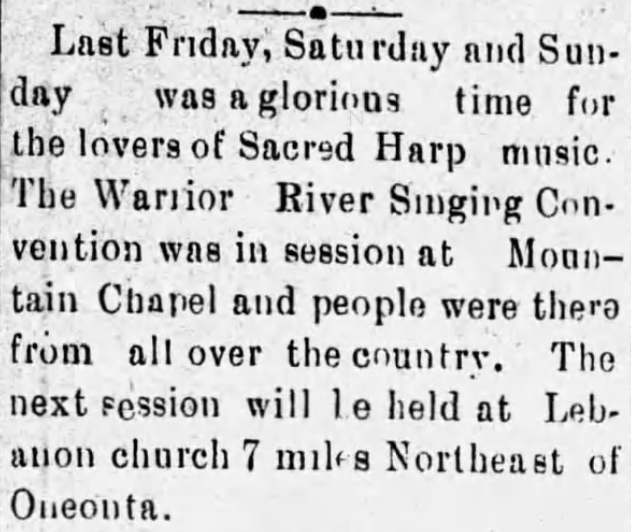
The upside down ə at the end of the 6th line of text, an unintentional schwa, adds a little rustic charm. There was a notice as recently as 2003 of “The one hundred twenty-ninth session of the Warrior River Convention… held at Hopewell Primitive Baptist Church in Oneonta, Alabama on Saturday before the first Sunday in August.”
Another short article from Thursday, July 08, 1909, paints a remarkable scene:
PREACHER DON’T LIKE ALL-DAY SINGING.
At Henryville quite an unusual occurrence took place when the people arrived for the all-day singing that was billed to take place there to find the doors of the church nailed up and a notice from the pastor, the Rev. A. D. Hill, informing the people that the church was closed to the all-day singing. Prof. B. F. Sims, of Martling, was engaged to conduct the singing, and, as usual, quite a large crowd had assembled and a very elaborate dinner had been prepared for the occasion. When the people learned of the conditions they were surprised and became indignant. The church trustees, the entire congregation, and the sheriff of the county met in brief conference, after which they proceeded to open the doors of the church in a very deliberate and literal manner, and proceeded with their song service.
B. F. Sims was a leader in gospel seven-shape singing, so this particular singing in 1909 was probably of that sort rather than four-shape Sacred Harp.
The main essay of this post was originally published in The Southern Democrat for Thu, Jan 24, 1907. So many of the features of our current singings are present: “All Day Singing” with “Dinner on the Ground”, singing the shapes before the poetry, “beating time” with the hands, and someone weeping! This was, however, at a time when only a handful of leaders would take turns to lead multiple songs, rather than everyone having an opportunity to lead one song.
What is a mystery is the poetic, existential, and almost autohagiographical nature of the writing by this mysterious “Murmurer,” a regular contributor to the paper at the time. The author’s reference to being “in slavery” is not literal but theological. In the revivalist Protestant idiom common to the rural South in 1907, the phrase would have been readily understood as Romans 6 language—describing the soul’s bondage to sin prior to conversion, rather than any condition of legal or economic servitude.
For the subject matter, the source, and the time and place this was published, it’s a striking essay.
THE SONG THAT TOUCHED MY HEART.
I attended a County Singing Convention today where they used the Sacred Harp. There were about two hundred singers, and half a dozen leaders, and at least fifteen hundred people present. It was an “all day singing” with “dinner on the ground.” When the “class,” as the leaders called the singers, was formed in a hollow square with a table in the center on which sat several pitchers of water, and the “leaders” ranged in their places, the singing began. First the “class” was instructed to “sound their parts,” and the tenor, treble, and bass sounded in beautiful unison. Then came the “notes” or “music,” the fa, sol, la, me, and how they did sing. Then after a slight pause for breath, the head leader said, “We will sing the poetry,” and at the proper signal, as one voice, there rang out the words of the song. And as they sang, a hundred hands “beat time,” sometimes two, sometimes three, and at other times “four beats to the measure” depending on the “time” in which the song was written.
And such songs as they did sing! How they moved my soul!
“Amazing grace how sweet the sound.”
“Shed not a tear o’er your friend’s early bier.”
“Hark from the tomb a doleful sound.”
“When we’ve been there ten thousand years, bright shining as the sun,” and dozens of others.
I sat there and the tears ran down my cheeks in spite of all my efforts to be brave, and I said I’ll write myself down in my next, murmuring a tender-hearted idiot.
* * * * *
If I were wholly free, I would tell you the thoughts these old songs brought to me, for it might do you good, and I am sure that it would help me. But still being in slavery, I dare not “wear my heart on my sleeve” and therefore I can only give you a glimpse of what I felt in my soul.
My mother sang these old songs and loved them. She was a beautiful singer, a beautiful woman, and a noble soul. She has been my guiding star through the quagmires and quicksands of life. She has been dead these many years, and since her death, she has many times been very close to me, and often has inspired me to do the best things of my life. Some poet has said that “music hath charms to soothe the savage breast,” and I suppose it is the savage in me that loves music so intensely. Yes, it is the savage, for that is really the better part of me after all, for that is the free part.
I hear these dear old-fashioned songs, and my mother comes very near to me, and the emotion I feel in my soul at such times is worth a king’s ransom. Then it is that her soul, freed from the limitations of the flesh, draws me, tugs at my soul, until I soar to heights of which it is impossible to speak in a language that could be understood except by those who have felt the same divine uplift.
* * * * *
Once more I am a boy, full of the absurd enthusiasm of youth, and I look out upon the world as something beneath my feet, and there is nothing I cannot accomplish. Nobility, purity, greatness fill my soul and I am one of God’s chosen ones to better the world and uplift humanity.
Ah, there comes another song. It is slow and melancholy. It tells of the trials and crosses of life, and I see the boy, now grown into manhood, but the earth is no longer beneath his feet. He lies prone upon the ground, his feet bleeding, his hands filled with dust and debris. The marks and furrows of sin are deep in his face, and the shadow of shame is on his soul.
Ah, God, look at the strong man in his weakness, the hopeless man in his misery, the fallen man in his shame. There is the picture, dear friends, of him who gives you from week to week, the murmurings and echoes of his heart. You would not lay your heart bare like that, would you? You would be too proud, too dignified, too self-possessed? Well, it is my mood to do it, so allow me to have my way.
The music continued, and I saw above the blackness of despair, the sin and shame, a radiant face, and a gentle voice whispered, “Arise, my child, I am with you.” Ah, mother, a thousand times have you thus come to me when it seemed to me that all was lost. I lived it all over again today when I heard the old songs, of long ago.
* * * * *
Listen, they are singing a song of triumph, and the deep bass notes touch that within my soul which came near being greatness and genius. Yes, if something, somewhere, had not slipped a cog, but it did, and now I can only feel greatness. But I thank God that I can and do feel it, and when I do, as I did today, multitudes tremble and hang on my words, thousands read my written page, and men and women everywhere have their souls awakened, developed and purified. I feel the soul of the painter within me, and my pictures move the world. My music thrills the universe, and men and women weep and rejoice at my slightest touch.
* * * * *
They are singing again and this time it is,
“I would not live always,
I ask not to stay,
Where storm after storm,
Rises dark o’er the way,” and I know that I am divine, and that this longing, this feeling of greatness, of genius, of power, is not in vain, but that when my soul is released from whatever it is that clogs and shackles it, I will do the things my soul longs to do, and be the things I desire to be. Then my soul will be free, and the “something lacking” which has so often spelled failure for me will be supplied, and I shall be satisfied. This is the strongest proof to me of my immortality; this is the “something within me that tells me I can never die,” but that so long as these soul longings to go up higher continues, I shall follow that star of divine hope which has guided my wanderings through countless æons.
MURMURER.
Leave a Reply